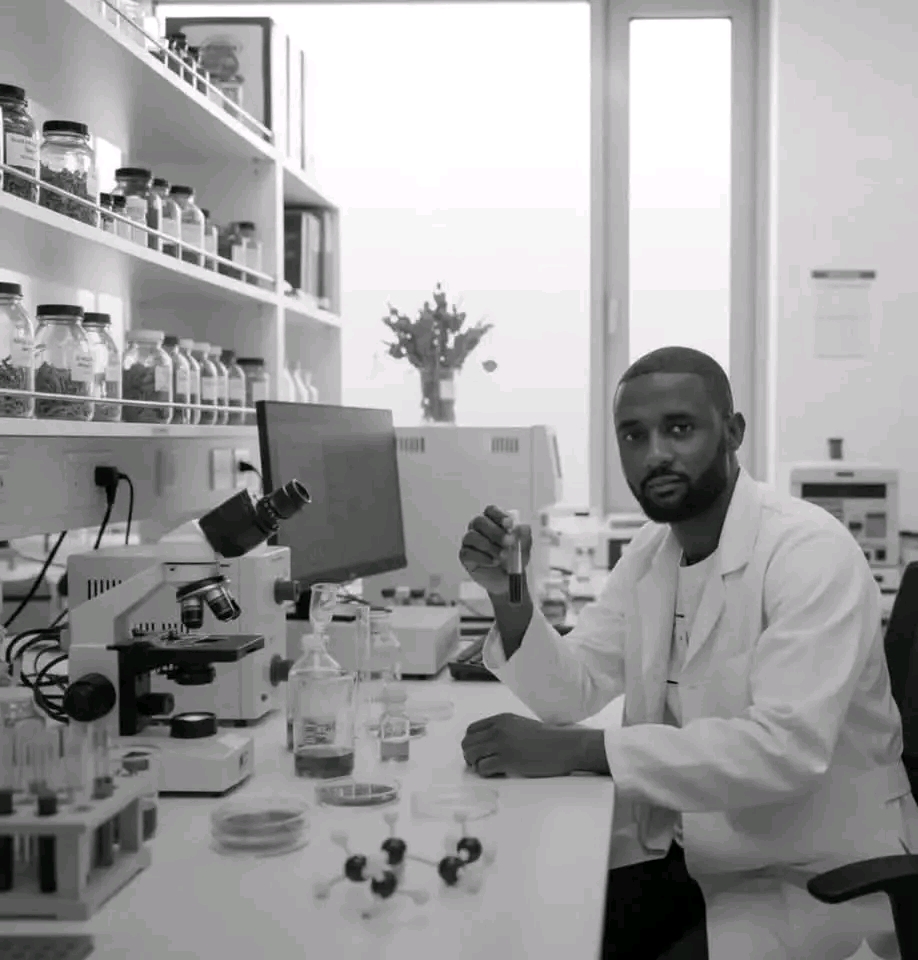
Dr Huzayifaa Mahamadawwal Shifaa is a health professional, researcher in natural medicines and medicinal plants, and an advocate for the development of natural therapy grounded in scientific evidence. His work is centered on bringing inherited knowledge of natural medicine into closer dialogue with modern medical science, laboratory investigation, clinical assessment, pharmacology and responsible patient care.
He is the founder and director of Giddu Gala Yaala Qoricha Aadaa Oromiyaa — the Oromia Center for Herbal and Traditional Medicine. The purpose of the Center extends beyond providing treatment and health guidance for different conditions. Its broader mission is to help transform knowledge that has traditionally been transmitted through generations and practical experience into a more systematic model supported by scientific investigation, laboratory assessment, diagnosis, clinical monitoring, quality control and patient safety.
Dr Huzayifaa was born in western Oromia, in Ilu Abbaa Booraa Zone, Diiduu Woreda, Korree Kebele, in the rural locality known as Busoo, to his mother Hamziyyaa Shamsuu and his father Sheikh Mahamadawwal Shifaa.
His relationship with health science did not begin only after completing secondary school or entering a college or university. Its foundations had already been laid much earlier, during childhood, through the environment in which he was raised. In that sense, the first university in Huzayifaa’s life was his own family.
He grew up in a household that valued knowledge, education, community service and practical understanding of natural medicine. From childhood, this environment exposed him to conversations about health, disease, the human body, medicinal plants and the use of natural materials in traditional healing.
His father, Mahamadawwal Shifaa, was known in his community as a public educator and as a person with practical knowledge of natural medicine. His interest was not limited to knowing and using medicinal plants. He also had a strong desire to search for additional remedies, expand existing knowledge and improve approaches to treatment. That environment had a significant influence on Huzayifaa’s curiosity and later direction.
While still in primary school, Huzayifaa had already begun listening to discussions about diseases, observing the use of medicinal plants, reading what he could find and asking questions about how different natural substances were used. This early exposure was not a substitute for formal professional training, but it became an important foundation for the scientific curiosity that would later grow through education and independent study.
Huzayifaa’s education did not begin only in the classroom. An important part of his earliest learning was formed within a family that gave knowledge and education a central place. From childhood, he enjoyed reading and learning new things, but what increasingly distinguished his approach was his unwillingness to accept information merely because it had been stated by someone else.
Questions of this kind accompanied his learning as he grew. Rather than depending on a single source or treating something heard from one person as final truth, he developed the habit of consulting different sources, comparing information, examining disagreement and trying to understand a subject from a broader perspective.
As his understanding of health science expanded, these questions became more systematic. If a plant was said to help a particular condition, he became interested in asking what active compounds it contained, what biological activity those compounds might possess, how they could act in the human body, what their mechanism of action might be, what dose might be relevant, whether toxicity could occur and what available research actually showed.
Studying Arabic in an Islamic educational setting gave Huzayifaa access not only to religious learning but also to books written in Arabic on health, disease, natural remedies and medicinal plants. Learning Arabic at an early stage therefore became a tool for reaching a wider body of knowledge.
As his command of English developed, his access to modern scientific and educational literature expanded further. His learning was no longer limited to Oromo traditional medicine or to plants known within his immediate environment. Through Arabic and English, he was able to read about historically important medical traditions, including Arab, Indian and Greek systems of medicine.
These sources exposed him to different ways in which medicinal plants had been prepared and used, how older medical systems understood health and disease, and how plant knowledge developed in different societies. This broadened his interests beyond the knowledge available within his family and local community.
At the same time, an important intellectual transition took place: he increasingly understood that the presence of a statement in an old medical text did not automatically mean that it had been confirmed by modern scientific evidence. From that point onward, one of his strongest interests became the scientific examination of knowledge inherited through generations, practical experience and historical literature.
The interest in health that began in childhood gradually developed into a more structured professional and scientific pursuit. Throughout his educational journey, Huzayifaa studied and developed knowledge in areas including Clinical Medicine, Pharmacology, Pharmacognosy, Clinical Pharmacy and related fields, while progressively deepening his focus on natural medicine and medicinal-plant research.
His interest in natural medicines did not stop at the simple statement that a particular plant may be used for a particular disease. His questions became increasingly pharmacological and scientific: What chemical constituents are present? Which compounds demonstrate biological activity? What is the mechanism of action? What dose is relevant? What toxicity may occur? Can the substance interact with other medicines? How can it be standardized? What do laboratory findings and clinical evidence show?
For this reason, Pharmacognosy, Herbal Pharmacology and Phytochemistry became important parts of his intellectual and professional development.
The later expansion of internet access and digital scientific resources widened this opportunity substantially. Scientific journals, peer-reviewed papers, textbooks and newly published research in English and Arabic made it possible for him to update his knowledge continuously and compare ideas across multiple scientific sources.
The breadth of this long-term learning sometimes appears greater than his age would suggest.
People who read his scientific articles on social media, websites and other digital platforms, as well as some who have known him for many years, have occasionally asked how he was able to accumulate such a range of knowledge at a relatively young age. The answer lies not in a single period of rapid learning, but in the combination of growing up in an education-oriented family, beginning to read early, spending long periods away from home for education, living in different environments, maintaining continuous independent study, pursuing formal education, following scientific research and repeatedly reassessing previously acquired knowledge.
During secondary school, his interest in health science became increasingly focused. He began independently reading books and other materials on medicine, biology, pharmacology and different diseases. As a result, when he later entered higher education, health science was not a completely unfamiliar field. It was a subject he had already been exploring for years through family influence, self-study, books and scientific reading.
In this way, Huzayifaa gradually brought together knowledge of health and natural medicine inherited from his family and local environment, material studied from historically established medical traditions, and knowledge gained through formal education and modern scientific literature.
The central area of Dr Huzayifaa’s professional interest is the study and use of natural medicines and medicinal plants through an evidence-based approach.
When a plant has been used by a community for many years for a particular condition, his approach is to ask what may explain that use scientifically. What compounds might be responsible? What pharmacological activity has been demonstrated? Could toxicity occur? What does laboratory research show? Has the substance been studied in humans?
In his view, traditional knowledge is an important intellectual resource, but for that knowledge to move into modern healthcare it must pass through appropriate scientific examination. In this model, inherited knowledge can generate a hypothesis; laboratory science can investigate active compounds and possible mechanisms; toxicology can assess safety; and clinical research can determine whether a meaningful patient benefit actually occurs.
Dr Huzayifaa considers the study of the identity, chemical composition, bioactive constituents, pharmacological properties, quality, toxicity and practical use of natural medicinal materials—particularly medicinal plants—to be essential.
His study interests include groups of compounds such as alkaloids, flavonoids, polyphenols, saponins, terpenoids, glycosides, volatile constituents and other bioactive substances. Research may identify antioxidant, anti-inflammatory, antimicrobial, antiviral, immunomodulatory and organ-protective activities among such compounds.
However, his position is not that a substance is safe simply because it is natural. Demonstrating activity in a laboratory does not by itself establish clinical effectiveness in humans. Dose, bioavailability, metabolism, toxicity, product quality, drug interactions and clinical evidence must all be considered.
For him, this distinction is one of the major differences between evidence-based natural medicine and the unstructured use of traditional remedies.
Dr Huzayifaa does not view modern medicine and natural medicine as two systems that must exist in opposition to one another.
Modern medicine has produced major advances in diagnostic medicine, laboratory science, medical imaging, surgery, emergency medicine, infectious-disease management and pharmacotherapy. At the same time, nature contains many molecules and compounds that may serve as sources or starting points for medicines, while inherited knowledge can sometimes help identify which natural materials deserve scientific investigation.
His aim is therefore not to weaken one system in order to replace it with another. His interest is in an integrative approach that brings together methods that are supported by evidence, demonstrate acceptable safety and provide meaningful benefit to patients.
Chronic diseases are among the major health challenges facing societies worldwide. Their effects extend beyond the disease itself, influencing the life of the patient, the family, working capacity and the cost of healthcare.
For this reason, Dr Huzayifaa believes that management of long-term illness should not be reduced to medicine alone. Prevention, early diagnosis, nutrition, lifestyle, mental wellbeing, pharmacotherapy, rehabilitation, laboratory monitoring and—where evidence supports them—complementary interventions may all have important roles.
In his view, treatment should not be judged merely by the label of the medical system from which it comes. The relevant questions are whether it is supported by evidence, whether it is safe and whether it improves patient outcomes.
Traditional medicinal knowledge has a long history in Ethiopia and across Africa, and many communities continue to use such services. For Dr Huzayifaa, however, this represents not only an opportunity but also a serious responsibility.
Using raw plant materials without known doses, preparing mixtures with unidentified ingredients, contamination, toxicity, adulteration and interactions with conventional medicines can all create risks for patients. Such problems may damage not only individual patients but also public trust in natural medicine as a whole.
The solution, in his view, is neither to abandon inherited knowledge completely nor to accept it without evidence. The appropriate path is through research, regulation, standardization, quality assurance, toxicology, pharmacovigilance and professional education.
He believes that professionals in medicine, pharmacy, pharmacology, botany, chemistry, microbiology, toxicology and public health should work together to distinguish useful inherited knowledge from unsafe practices, identify promising medicinal resources and move those that deserve further investigation toward higher levels of clinical research.
To translate this vision into practical work, Dr Huzayifaa founded and leads the Giddu Gala Yaala Qoricha Aadaa Oromiyaa — Oromia Center for Herbal and Traditional Medicine.
The Center was established around the goal of advancing natural medicine on a scientific basis, providing organized services to patients, studying medicinal plants, encouraging laboratory-based assessment, supporting public health education and helping move inherited therapeutic knowledge toward a modern evidence-based framework.
Its objective is not simply to reproduce traditional remedies in the same form in which they were used in the past. Rather, it seeks to identify knowledge that deserves further investigation, examine it using scientific methodology, document outcomes, assess safety and contribute to the development of more systematic evidence-based natural medicine.
Another major part of Dr Huzayifaa’s work is public health education.
He believes that scientific knowledge cannot benefit society fully if it remains confined to universities, laboratories and academic journals. For that reason, he has devoted substantial effort to communicating advanced health and scientific information in Afaan Oromoo on topics including liver disease, infectious diseases, chronic diseases, pharmacology, natural medicines and prevention.
Reading scientific publications, analyzing and comparing evidence, translating complex ideas and presenting them in Afaan Oromoo in a form that can be understood both by educated readers and by the wider public has become an important part of his work.
This effort also contributes to the development of medical terminology and scientific communication in Afaan Oromoo, while helping communities gain access to more reliable health information and protect themselves from misinformation.
Patient safety is one of the central principles in Dr Huzayifaa’s professional outlook.
Whether a medicine is natural or synthetic, the first question should not simply be, “Does it work?” It should also include: Is it safe? For whom is it appropriate? For whom may it be unsuitable? What is the appropriate dose? What interactions are possible? How strong is the evidence?
He emphasizes that making unsupported promises to patients, encouraging them to stop necessary treatment, delaying diagnosis or replacing emergency medical care with unproven alternatives is incompatible with a scientific and responsible approach to natural medicine.
Looking ahead, Dr Huzayifaa aims to expand his work toward higher levels of scientific research and to strengthen collaboration with universities, laboratories, hospitals, researchers and research institutions.
His long-term objectives include carrying out phytochemical characterization, toxicity studies, pharmacological testing and clinical research on promising medicinal plants; standardizing formulas that have shown useful results in practice; and evaluating their outcomes through methods that can be independently verified.
For him, genuine science does not consist only of recording positive findings. A result that fails to confirm a proposed benefit is also scientifically important. The purpose of research is not simply to prove a preferred claim, but to determine what is actually true.
His vision is therefore not to diminish modern medicine, nor to elevate traditional medicine without evidence. It is to construct a bridge between them.
That bridge cannot be built by tradition alone, and it cannot be built by technology alone. It must be supported by research, laboratory science, clinical evidence, quality control, ethics, pharmacovigilance, professional collaboration and respect for patients.
Knowledge should not be judged solely by where it comes from. A treatment should not be accepted or rejected simply because it is described as “modern” or “traditional.” The decisive questions are: What is the evidence? What is the safety profile? What is the quality? What meaningful benefit does it provide to the patient?
The central goal of Dr Huzayifaa Mahamadawwal Shifaa’s work is to investigate inherited medical knowledge and Ethiopia’s medicinal-plant resources through modern science, contribute to the development of organized and evidence-based natural medicine, provide communities with reliable health information, expand scientific health communication in Afaan Oromoo and collaborate with professionals from different fields to build a model of care that brings together science, safety, evidence and humanity.
His educational journey has never been limited to one path, and he does not believe that professional ability should be measured by titles alone. At the same time, he considers every activity that affects human health to carry a high level of responsibility.
For that reason, he regards continuous learning, questioning what is already believed, investigating what is not yet understood, accepting new evidence and revising previous views when better evidence emerges as essential characteristics of a scientific professional.
At present, the Oromia Center for Herbal and Traditional Medicine provides natural-medicine services for more than 30 health conditions, with an emphasis on quality, scientific understanding and responsible care.
The Center provides research-informed natural-health services with scientific awareness and professional responsibility. Patients who are unable to attend the Center in person may explain their health condition, complete the required medical investigations where they are located and send their laboratory or diagnostic results for review. Depending on the service required, patients within Ethiopia and abroad may also receive further guidance and arrange delivery of medicines to their location.
For inquiries, patients may contact the Center using the telephone numbers below and send their concerns in writing through WhatsApp, Telegram or SMS.
Oromia Center for Herbal and Traditional Medicine