WHO Publication 2026 146 PagesMental Health Policy
Mental health care is undergoing an important transformation worldwide. Increasing attention is being directed toward models of care that protect human rights, promote personal autonomy, support recovery, and enable people experiencing mental health conditions to live meaningful lives within their communities.
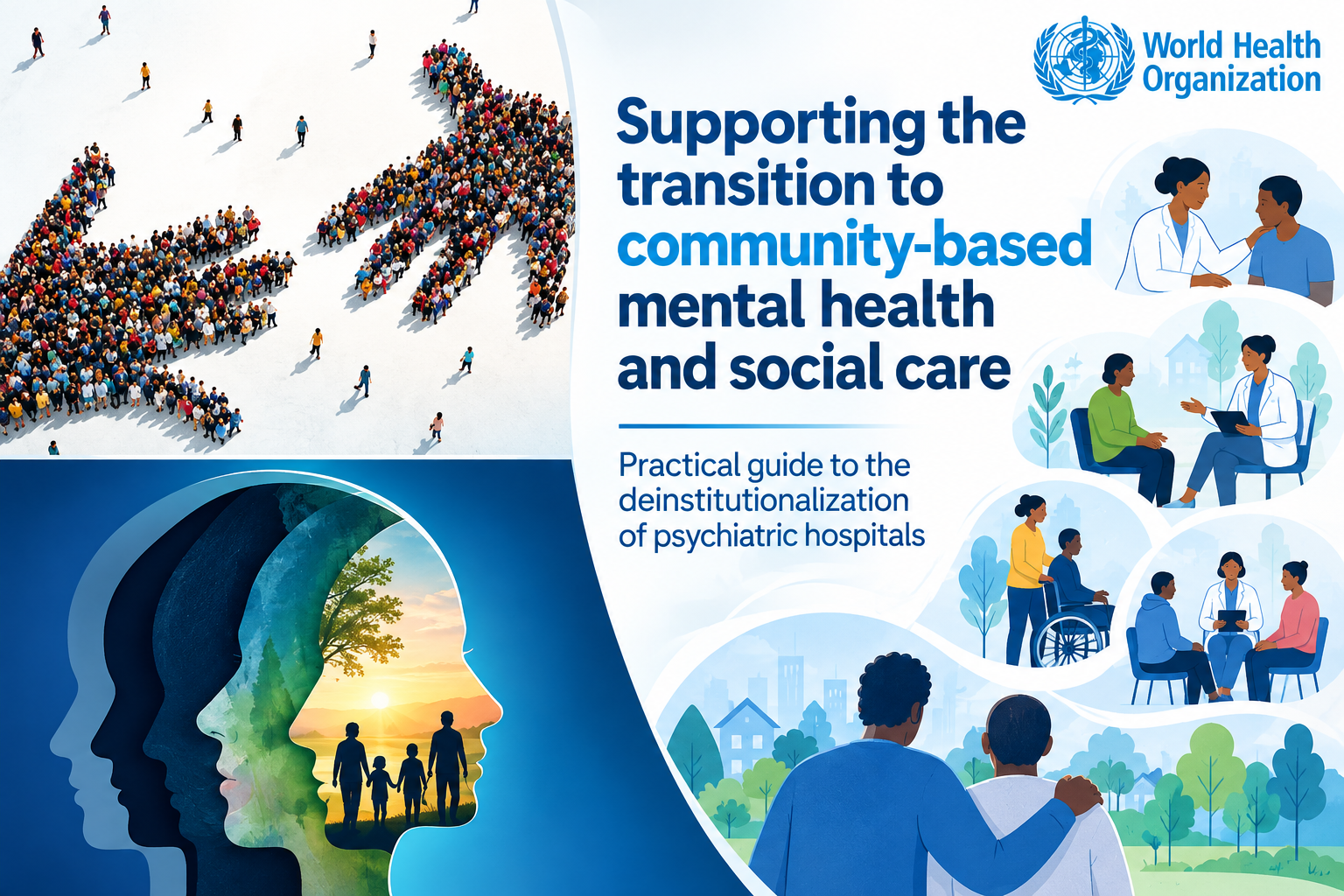
The World Health Organization (WHO) has published a comprehensive practical guide entitled Supporting the Transition to Community-Based Mental Health and Social Care: Practical Guide to the Deinstitutionalization of Psychiatric Hospitals. The publication provides practical direction for psychiatric hospital leaders, health-system planners, policymakers, and community partners working to transform mental health services.
Its central message is that effective mental health care should not depend primarily on long-term institutionalization. Instead, mental health systems should develop coordinated networks of accessible, person-centred, rights-based services delivered within communities.
In many countries, psychiatric hospitals continue to occupy a central position within mental health systems. These institutions may absorb substantial financial and human resources while serving a relatively limited proportion of people requiring mental health care.
Long-term institutional care can separate individuals from their families, communities, employment opportunities, and social support networks. Institutional environments may also restrict autonomy, limit participation in personal decisions, and create conditions in which dignity and human rights are insufficiently protected.
WHO emphasizes that mental health reform requires moving beyond institutional models toward services that are accessible, individualized, recovery-oriented, and integrated into community life.
The WHO guide presents international indicators illustrating the continuing reliance on psychiatric hospitals.
81%
47%
28%
49%
Deinstitutionalization refers to the planned transition from long-term institutional psychiatric care toward comprehensive networks of community-based mental health services and social support. The process involves more than changing the physical location where treatment is delivered.
It requires changes in policies, legislation, financing, professional practice, service organization, and public attitudes toward people living with mental health conditions.
Successful deinstitutionalization should strengthen personal autonomy, promote social inclusion, improve access to treatment, and support individuals in making decisions about their own lives.
Deinstitutionalization does not mean discharging people without appropriate care, transferring responsibility to families without support, or closing hospitals before suitable community services are available.
Community-based mental health care consists of interconnected services that enable people to receive appropriate treatment and support within or close to their communities.
These services may include primary health care, mental health services in general hospitals, specialized community mental health teams, psychosocial rehabilitation, peer-support programmes, supported housing, and social assistance.
The approach recognizes that mental health recovery is influenced not only by clinical treatment but also by living conditions, social relationships, education, employment, financial security, and community participation.
| Area | Institutional Care | Community-Based Care |
|---|---|---|
| Accessibility | Often concentrated in specialized institutions. | Services closer to people’s homes and communities. |
| Autonomy | Institutional routines may limit personal choices. | Greater emphasis on choice and participation. |
| Social Connection | Long stays may separate people from social networks. | Supports relationships and community inclusion. |
| Living Conditions | Shared environments with potentially limited privacy. | Individualized living arrangements and supported housing. |
| Recovery | Institutional practices may restrict independence. | Emphasizes recovery, functioning, and quality of life. |
The WHO guide organizes practical implementation into three interconnected phases: Plan, Prepare, and Provide.
The planning phase establishes the organizational and operational foundation for mental health service transformation.
- Establish a transition oversight committee.
- Conduct a comprehensive situation analysis.
- Assess existing psychiatric hospital services.
- Map available community services and resources.
- Engage relevant stakeholders.
- Develop a transition plan and budget.
The preparation phase develops the services, workforce capacity, partnerships, and individualized support arrangements needed for successful transition.
- Build acceptance and support for reform.
- Assess individual needs and strengths.
- Develop person-centred recovery plans.
- Coordinate health and social care.
- Expand community mental health services.
- Strengthen professional competencies.
- Develop supported living arrangements.
- Promote peer support and family engagement.
The implementation phase focuses on delivering improved care, supporting transitions into community settings, and sustaining long-term changes.
- Improve quality of care and institutional practices.
- Strengthen rights-based treatment.
- Support gradual transitions to community living.
- Prevent unnecessary long-term admissions.
- Improve admission and discharge practices.
- Redirect resources toward community services.
- Monitor and evaluate implementation.
A central principle of the WHO guidance is that mental health services must respect the dignity, rights, preferences, and autonomy of people receiving care. The guide emphasizes meaningful participation in treatment decisions, protection against discrimination, respect for personal choices, and access to appropriate support for independent community living.
It also highlights the importance of involving people with lived experience of mental health conditions in service planning, implementation, and evaluation. These principles are consistent with international human rights frameworks, including the United Nations Convention on the Rights of Persons with Disabilities.
Successful reform requires a well-trained and coordinated mental health workforce. Psychiatrists, physicians, mental health nurses, psychologists, social workers, occupational therapists, community health professionals, and peer-support workers may all contribute to community-based care.
WHO recommends strengthening professional competencies through training, supervision, collaborative care, and person-centred clinical practice. Hospital staff may also take on new roles in community services as mental health systems evolve.
Transitioning from psychiatric hospital care to community living requires careful planning and coordinated support. Individual needs should be assessed, and appropriate treatment, housing, social assistance, and follow-up arrangements should be established before transition.
Continuity of care is particularly important for individuals with complex mental health conditions, long-term support needs, or limited family and community resources. The guide stresses that people should not be discharged without access to necessary health and social services.
Monitoring and evaluation are essential components of sustainable mental health reform. Health systems should assess whether services are becoming more accessible, responsive, rights-based, and effective.
Relevant areas include service quality, continuity of care, community participation, housing stability, resource allocation, and the experiences of people receiving services. Regular evaluation allows decision-makers to identify gaps, improve implementation, and adjust strategies to local circumstances.
The WHO guidance provides a practical framework for health-system leaders seeking to modernize mental health care. Its implementation requires political commitment, appropriate financing, multisectoral collaboration, workforce development, and sustained investment in community services.
For countries with limited mental health resources, the guide highlights the importance of context-specific, gradual, and coordinated reform. Hospital-based services remain important for specialized and acute clinical needs, but long-term institutionalization should not be the default model of mental health care.
The WHO practical guide represents an important resource for transforming mental health systems toward more inclusive, accessible, and rights-based care. Its recommendations emphasize that deinstitutionalization must be carefully planned, adequately supported, and implemented alongside the development of comprehensive community services.
The ultimate objective is not simply to reduce reliance on psychiatric hospitals, but to improve the lives, dignity, autonomy, and social participation of people experiencing mental health conditions.
Health professionals, policymakers, researchers, and service managers are encouraged to consult the complete WHO publication for detailed implementation guidance, practical tools, case studies, and supporting references.